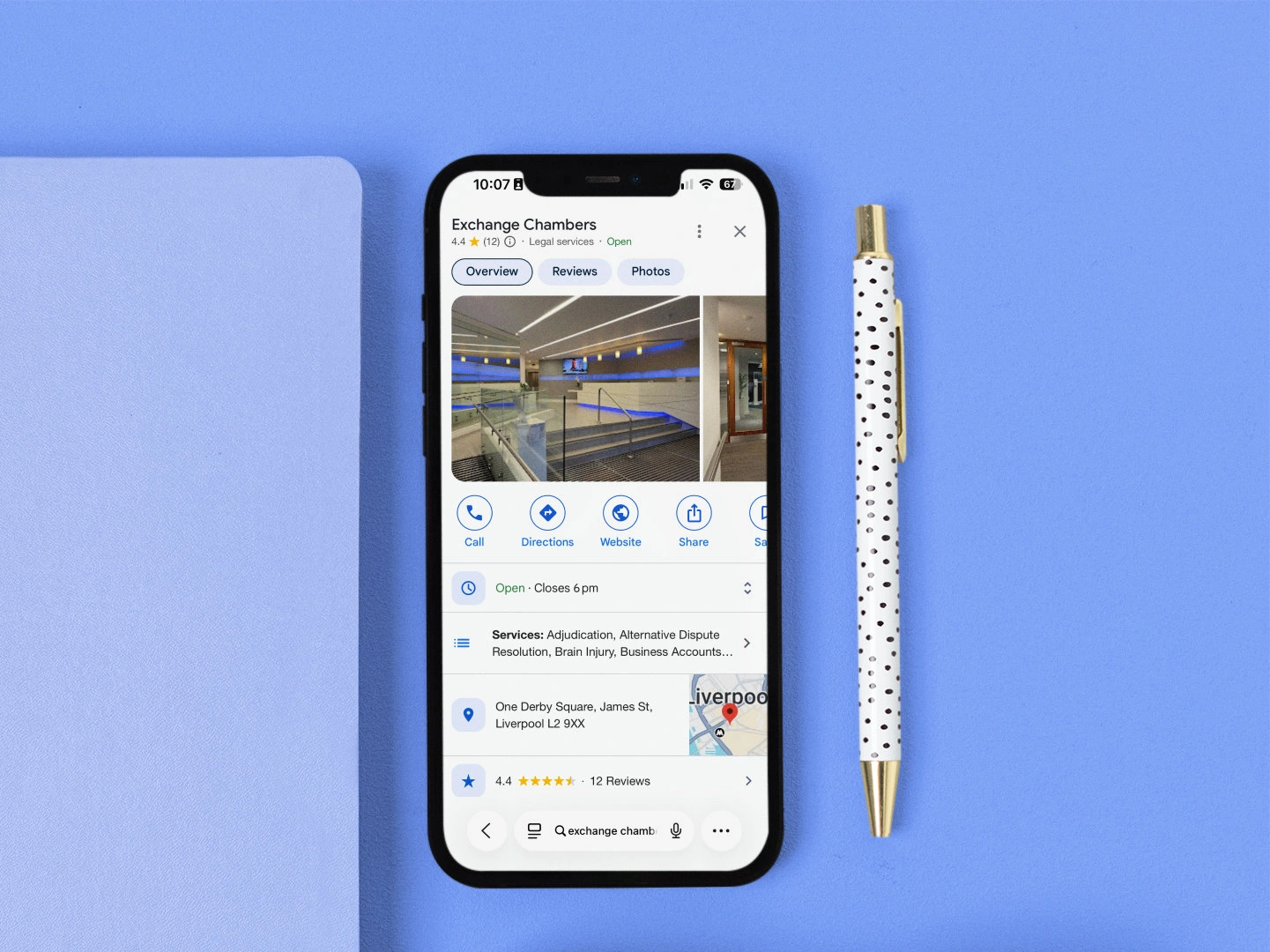

Few Google products have caused as much quiet confusion as Google Business Profile. Once called Google My Business, a name that sounded more like an instruction than a product, it was renamed in 2021 and has since become one of the more important places an organisation appears online. This guide has been updated to reflect how the tool has changed over the past three years, including tighter verification, a redesigned way of managing profiles, and the growing role of AI in search. A complete profile now shapes not only the search listing but the AI-generated summaries Google shows above it. This post explains what the tool is, how to set it up, and why a well-populated profile matters more than ever.
What is Google Business Profile?
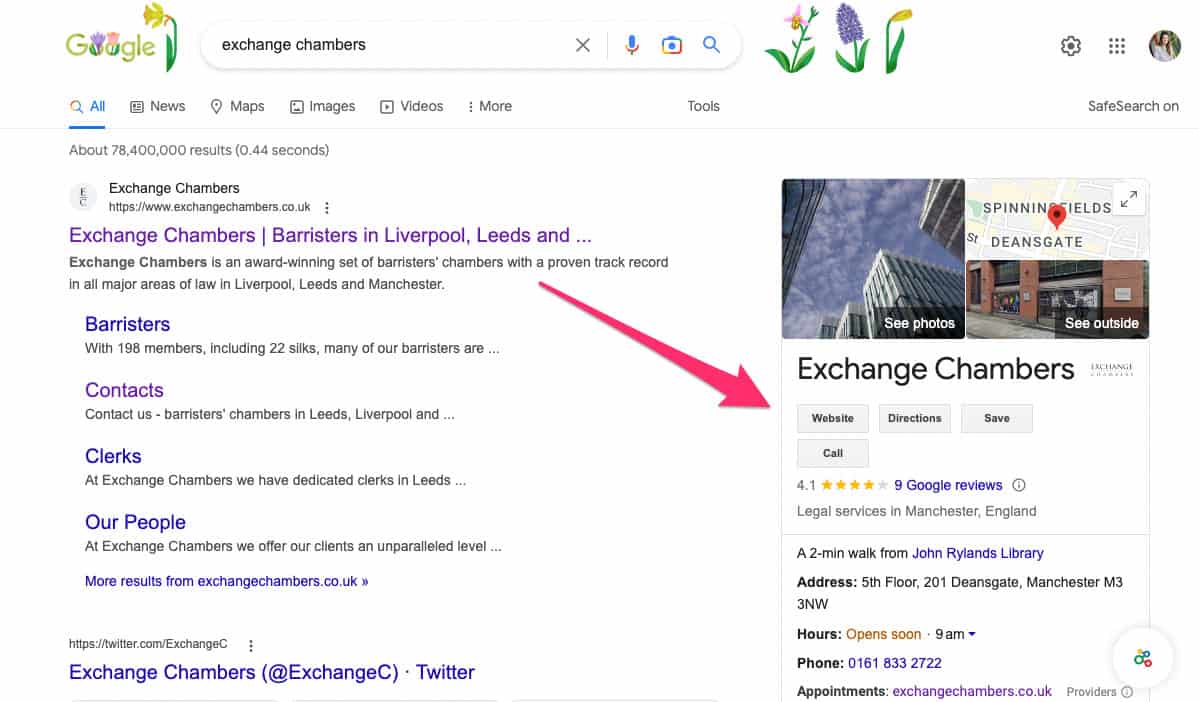
Google Business Profile is the panel that appears on the right-hand side of the Google search results page on desktop, and at the top of the results on mobile. To see yours, enter your organisation’s name in the search field and press enter (do not let it auto-populate with your URL, or it will send you straight to your website). You will probably see something like the example below (see the red arrow).
Why should we set up Google Business Profile?
There are many good reasons why you should take the time to set up Google Business Profile. Here are the top five:
1. Search engine optimisation
Every time you create an online property associated with your organisation and link back to your website, you remind Google of your presence and give users another way of accessing your website. This increase in your website’s visibility and accessibility will, in turn, contribute to search engine optimisation (SEO). Improved user experience will always contribute to SEO.
2. Free advertising & access to on-page prime real estate
Your Google Business Profile appears in the top right-hand corner on a desktop screen, and at the top of Google search results on a mobile device. This positioning can double your on-page exposure, as the example search above shows: the profile can fill much of the screen, and it costs nothing beyond a few minutes spent wrangling with a Google account.
3. Credibility
Such visibility establishes immediate credibility and reassurance about your organisation.
4. Trust & confidence
On top of the visibility of your organisation and the reassurance that it gives prospective clients, Google Business Profile also gives you the opportunity to feature independent reviews from clients. A high review score, say four and above, will translate into confidence in your organisation and increase trust.
5. Location & connection services
On a more practical level, completing your Google Business Profile can help clients find and connect with you. The tool has the following features to support this:
- Address & map – ensures that you appear on Google Maps and that clients can find you easily.
- Directions button – launches Google Maps and immediately plots a course to your organisation from wherever the user is.
- Opening hours – so that clients know when they can communicate with you.
- Call button & linked phone numbers – this makes it very easy for clients to ring you without having to dial the number into their phones.
- Leaving reviews – an easy way for clients to give you feedback.
Google Business Profile and AI search
Google’s results are no longer limited to a list of blue links. AI Overviews, and the newer AI Mode, now summarise answers directly at the top of many searches, and these summaries draw on the same local business data held in your Google Business Profile. In practice, this makes a complete, accurate profile more valuable than before, not less.
A few points are worth understanding:
- Google’s AI features pull directly from Business Profile data when answering local queries, so the name, description, services, opening hours, reviews and photos you provide can all feed the answer a prospective client sees.
- Being named matters as much as ranking. AI summaries often answer the question in place, so clear, factual profile content that states plainly who you are and what you do gives Google something accurate to credit.
- Completeness compounds. A sparse profile gives the AI little to work with, while a detailed one, kept current, is more likely to be surfaced and quoted.
For chambers and firms, much of your search traffic will still come from people looking you up by name, or through referral, and AI Overviews appear less often for short, simple local searches than for longer, question-style ones. Even so, your profile is the trusted data source that underpins the knowledge panel and, increasingly, the AI answers built on top of it. Keeping it complete and accurate is a low-effort way to stay visible as search continues to change.
How can we access our Google Business Profile?
Some clients have phrased this question as ‘how can we break into our Google Business Profile?’ I promise it isn’t that hard, but it may involve snail mail, so it can feel like a somewhat monumental task with many elements beyond one’s control. That said, it really isn’t.
First of all, you need to check your Google Business Profile status. Enter your organisation’s name in the Google search field and hit enter (as before, don’t let it auto-populate with your URL, or it will send you straight to your website).
Possible outcomes:
1. Nothing appears on the right side of the search results.
If nothing appears on the right side, but you appear at the top of the list of search results, the chances are your organisation has not registered as a business with Google Business Profile. It is very easy to register; follow the steps below.
2. Your organisation appears on the right side, but you (or your colleagues) haven’t created the profile.
Don’t worry. You can take back control of the asset. On the Google Business Profile, just below the organisation’s address, business hours and phone number, look for the ‘Own this business?’ link. Selecting it starts the process of taking ownership of the profile, after which Google will guide you through verification.

3. Your organisation appears and it recognises you as an editor of the Google Business Profile.
If you are signed in to a Google account associated with the profile, Google will recognise you as an editor and show your management options directly within Search and Maps. Google has retired the separate dashboard for single-location businesses, so you now manage the profile by searching your business name (or “my business”) while signed in. You must be logged in for this to work. If you know you are a verified editor but cannot see these options, sign in at the Google Account sign-in page and try again.
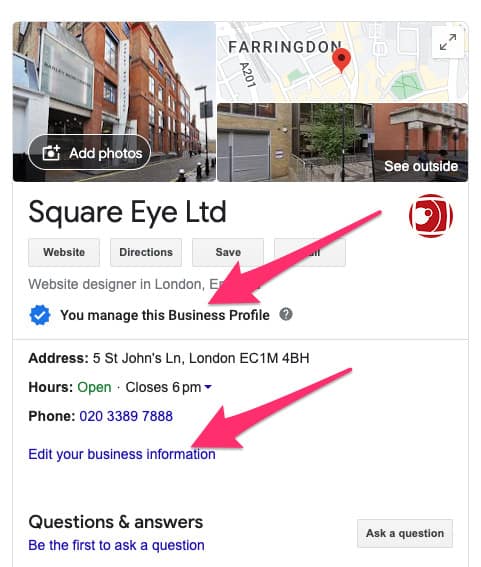
4. Your organisation appears, but the profile is held by someone else
This is common where a former colleague set the profile up, or a third party claimed it. If no one at your organisation currently holds owner or manager access, you can request it through Google. In outline, this means finding the listing, selecting the option to request access, and verifying your connection to the business. Google then contacts the current profile holder before deciding whether to grant access, so the process can take time.
To avoid this situation, make sure more than one person holds owner or manager access, either through an organisational Google account that mulitple people have access to (although access and credentials can still get lost) or a stable third party, like your web design and support agency. If the original account holder later moves on, the profile can still be managed without interruption.
How to register for Google Business Profile
- Sign in to your Google Account on your computer or create a Google account. If you are creating a new account, sign up with your organisation’s email address.
- Go to create a profile.
- Enter the name of your business and address.
- Search for your business category.
- Add your phone number, website and other details.
- Click ‘Next’ as directed.
- At the end of the process, select ‘Finish’.
- Choose a verification method. Google offers several, and the options available will vary from business to business. Video verification, either a short recorded walkthrough or a live video call showing your premises and signage, has become the most common method, while postcard verification is no longer offered to everyone. If you have already verified your website in Google Search Console, you may qualify for instant verification, which is usually the quickest route.
Troubleshooting and common issues & oversights
Image selection
Incorrectly sized or absent images can look unprofessional. Choose images that fit the space and convey the impression you want to give.
Service area
If you do not have a shopfront or walk-in location that clients can visit, you may want to set a service area instead of a street address.
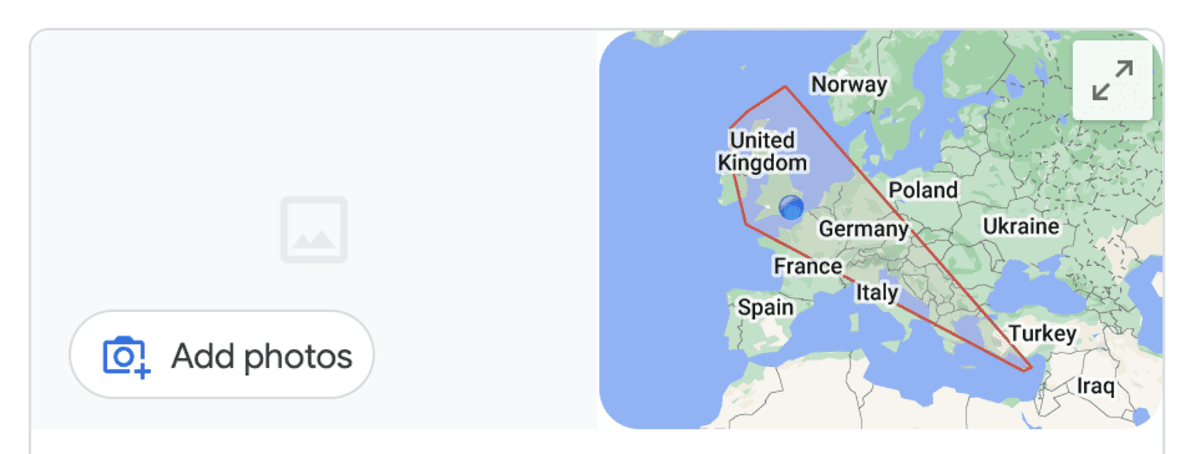
Take care with how broad you go. Google has tightened its service-area rules, and very large or country-wide areas can be rejected or trimmed, so it is best to define the specific regions you serve. If you work across the whole of the UK, listing England, Wales, Scotland and Northern Ireland as separate areas tends to produce a sensible map. Avoid selecting “United Kingdom” as a single area: as well as being broader than Google now prefers, it has historically pulled in a stray part of Cyprus and skewed the map, as the example below shows.
Elements of the Google Business Profile that often get overlooked:
Icons
The icon space can be used to add your organisation’s logo to your profile. If this is not populated, the listing is left unbranded, and an opportunity is missed.
Business description
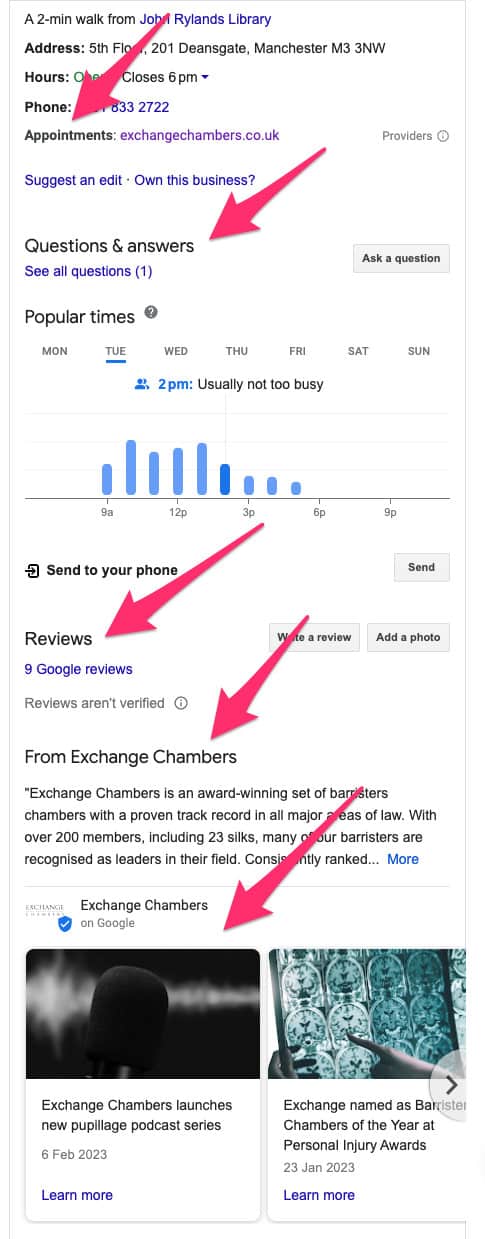
In the backend of Google Business Profile, this field is called ‘Business description’. In the frontend, it appears at the bottom of the asset under the subheading ‘ From [organisation name]’. This gives you an opportunity to give prospective clients a flavour of your organisation.
Updates feature
This functionality can be used to post about upcoming events, feature client testimonials and promote anything you like. It works best if an image accompanies the post.
Questions & answers
It is meant for clients to ask you things, but you could post commonly asked questions here and then answer them as a way of sharing pertinent information.
Services
You can add all the services your organisation offers in the backend of your Google Business Profile. You can even create custom options if you don’t see the ones you need. None of these services will be seen on the frontend of your listing, but they will be associated with your listing should someone search for those services.
Bookings
Referred to as ‘Appointments’ on the frontend and ‘Bookings’ on the backend. You can set up a direct link to your appointment or event booking page.
Reviews
You may not feel your organisation needs Google reviews, but their absence can stand out if your competitors display a strong star rating. Google makes reviews easy to capture, and the review link can be built into your usual feedback request forms. Encouraging a handful of genuine reviews is a simple way to build confidence in prospective clients. In their own words (as you can see below), they suggest you could have twice as many customers if you have five reviews or more.

Analytics
Google Business Profile keeps its own statistics, separate from Google Analytics. This data is now labelled ‘Performance’ƒ and is reached from the profile’s management options. It shows how people find and interact with your listing, such as searches, views, calls and direction requests. Note that Google simplified these reports in 2025, so some low-volume search terms no longer appear.

How can Square Eye help?
Square Eye can review your Google Business Profile and make specific suggestions about how it could be improved.
Adding Square Eye as a manager of the profile is a simple, preventative measure. It means a trusted second party retains access, so the profile can continue to be maintained even if the original account holder is no longer available and new managers can easily be given access when necessary. Please contact us at [email protected].