
Most legal sector websites still behave like digital brochures.
They present information about the firm or chambers, list people and services, and rely on visitors to work out for themselves whether the organisation can help them.
For many organisations, this approach is no longer enough. Clients arrive with specific problems to solve, limited time, and an expectation that information should be easy to find. At the same time, firms and chambers often have broad expertise across many sectors, jurisdictions and practice areas.
Increasingly, the answer lies in moving beyond the brochure model and building websites that actively guide clients towards the expertise that matters to them.
From static pages to guided journeys
A traditional website structure tends to reflect the organisation itself. There might be sections for practice areas, people, news and publications, each with long lists of content.
But visitors rarely think in these terms. They arrive with questions such as:
- Who is the right lawyer or barrister for this problem?
- Does this firm have experience in my sector?
- Have they handled similar cases before?
- Are they active in my jurisdiction?
An effective website should help answer these questions quickly.
Rather than expecting visitors to navigate complex structures, modern sites increasingly guide users through curated pathways. A page about a particular service might bring together relevant people, case studies, articles and events in one place, helping visitors build confidence in the firm’s expertise.
This approach helps broad organisations feel more focused to each individual visitor.
Understanding different audiences
Law firms and barristers’ chambers typically serve a range of different audiences. For example:
- solicitors referring work to chambers
- in-house legal teams
- international law firms
- corporate decision-makers
- journalists or researchers
Each audience may be interested in slightly different information. A solicitor might want to identify the right barrister quickly, while a corporate client may want reassurance about experience in a particular sector.
An intelligent website recognises these differences and adapts the experience accordingly.
Sometimes this simply means structuring content so that it can be easily recombined and presented in different contexts. In other cases, it may involve personalisation or conditional content that changes depending on the visitor.
Making expertise easier to discover
One of the most valuable roles a website can play is helping visitors discover relevant expertise they might otherwise miss.
For example, a visitor reading about professional negligence might also be shown:
- barristers or lawyers specialising in that area
- recent cases or matters handled by the firm
- related articles or commentary
- upcoming seminars or events
By connecting related content in meaningful ways, the website becomes a discovery tool rather than just a repository of information.
This not only improves the user experience but also helps firms showcase the depth of their expertise.
Using personalisation and context
Some firms are beginning to tailor parts of their website to different audiences or contexts. This does not mean building completely different versions of the site. Often it simply involves adjusting which content is emphasised or suggested to a visitor.
Here are a few practical examples.
Highlighting relevant expertise by location
A firm with international work may want to highlight different content depending on where the visitor is located.
For example:
- visitors from the US might see international arbitration or cross-border disputes more prominently
- visitors from the UK might see domestic litigation or regulatory work
- visitors from particular regions might see lawyers with relevant jurisdictional experience
This kind of location-aware content can often be implemented at hosting or platform level. Some hosting providers (including Kinsta) offer IP-based geolocation features that allow content blocks to change depending on the visitor’s location.
Tools such as PersonalizeWP or conditional content plugins can also be used to show or hide specific sections of a page based on simple rules.
Guiding visitors to the right people
One of the most common challenges on chambers and law firm websites is helping visitors identify the right lawyer or barrister quickly.
A practical approach is to connect people, expertise and content through tagging.
For example:
- each barrister or lawyer profile might be tagged with practice areas, sectors and jurisdictions
- articles, cases and events can be tagged in the same way
- pages can then dynamically display related people and content
This means that a visitor reading about construction disputes might automatically see the relevant barristers, recent cases and commentary in that area.
In WordPress, this kind of approach is typically implemented using taxonomies and dynamic queries. Many firms already have the necessary content – it simply needs to be structured in a way that allows the website to assemble it intelligently.
Adapting content based on how visitors arrive
Another useful tactic is adjusting the page experience depending on how a visitor reached the site.
For example:
- visitors arriving from a newsletter might see a prompt to subscribe
- visitors arriving from LinkedIn might see related thought leadership content
- visitors coming from a particular campaign might see a more prominent call to contact the relevant team
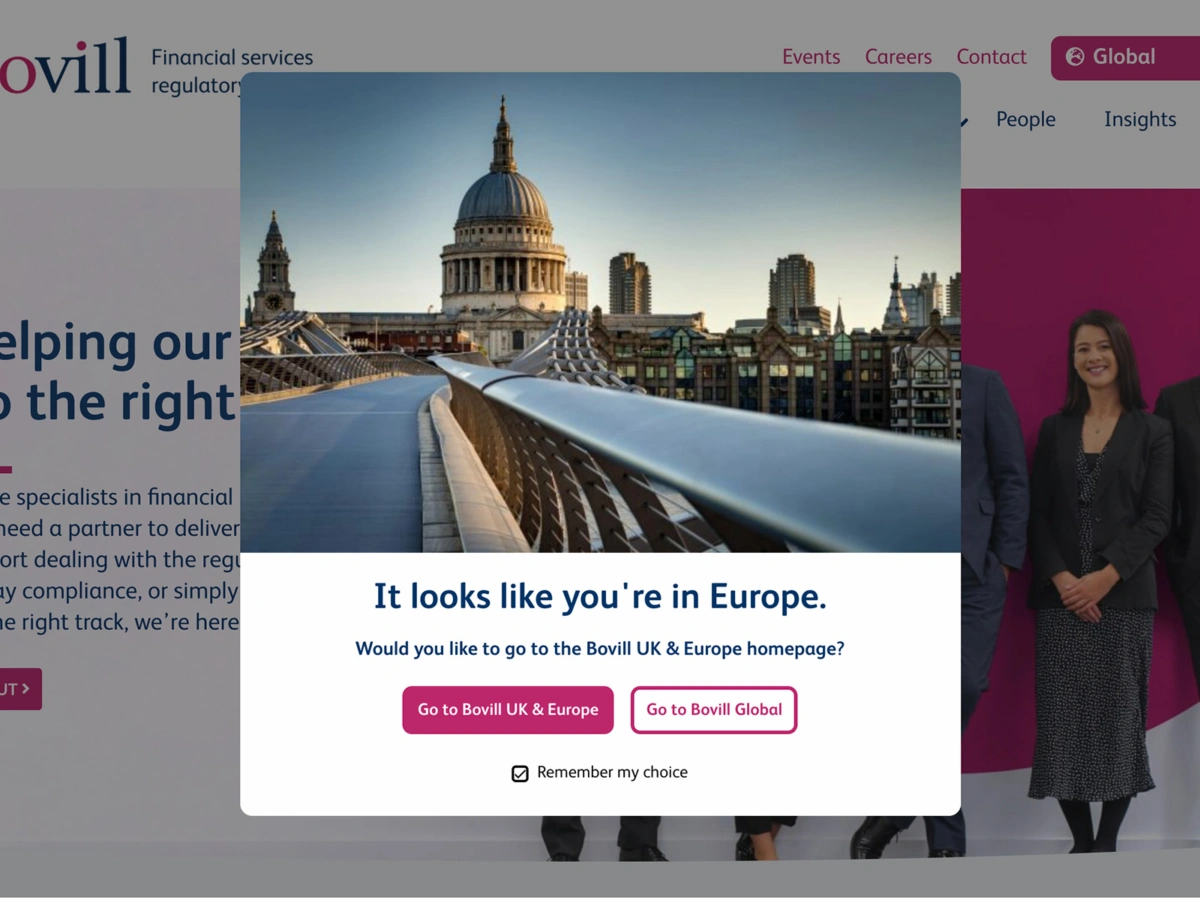
Detecting the visitor’s location and guiding them to the right content.
Tools such as RightMessage are designed for this type of behavioural personalisation, allowing content to change based on referral source, campaign parameters or previous visits.
Prioritising content for different audiences
In some cases, visitors may be willing to identify themselves in order to receive more relevant information.
For example, a site might allow visitors to indicate that they are:
- a solicitor referring work
- an in-house lawyer
- a journalist
- a corporate client
Once selected, the site can highlight the most relevant content for that audience, such as referral information, sector expertise or media commentary.
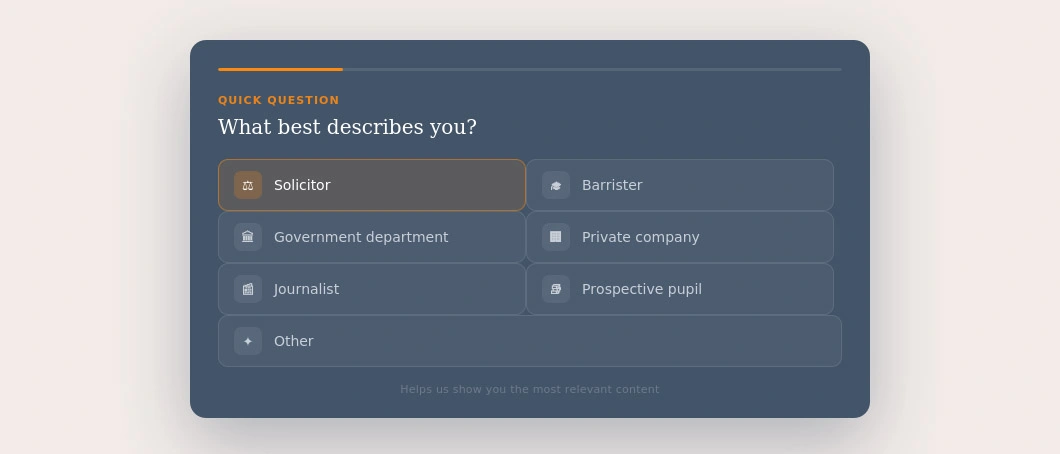
If the site visitor answers this simple question, you can tailor your site to their needs.
Some organisations implement this through simple preference selectors, while others integrate with marketing automation tools like HubSpot, Mailchimp or ActiveCampaign.
Multilingual and jurisdiction-aware content
Firms working internationally may also want to tailor content by language or jurisdiction.
Plugins such as WPML allow firms to maintain multilingual content while ensuring that visitors automatically see the most relevant language version of the site.
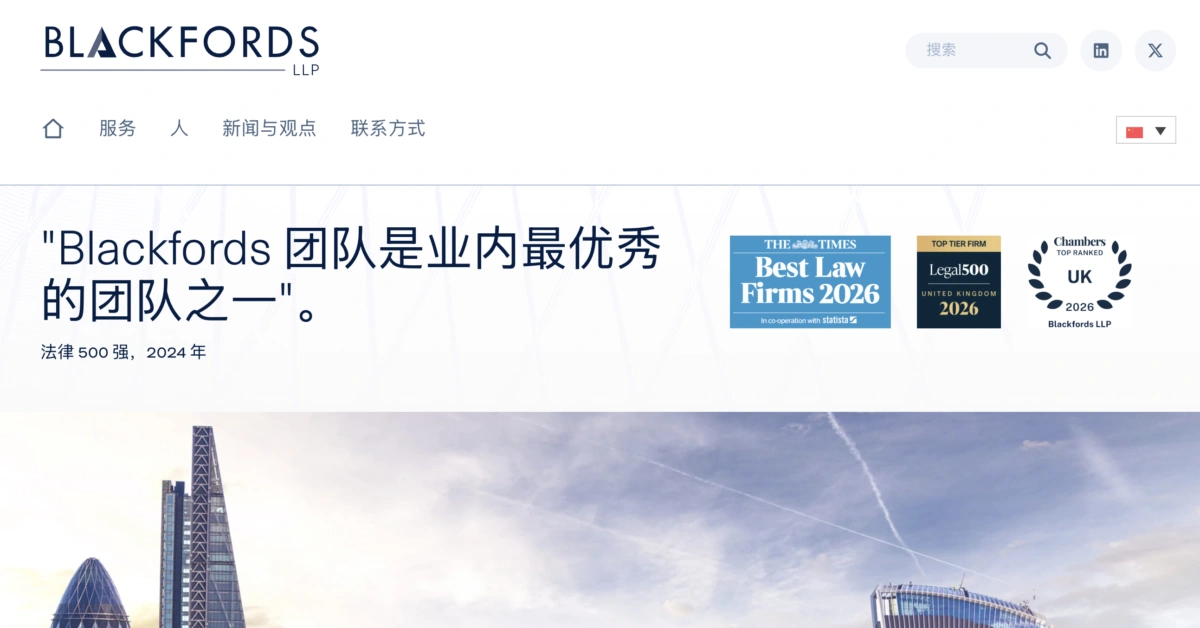
We help Blackfords LLP publish its website in four languages.
Combined with geolocation or campaign targeting, this can create a much more relevant experience for international audiences.
Practical examples for barristers’ chambers and law firms
Helping solicitors identify the right barrister quickly
One of the most common journeys on a chambers website is a solicitor looking for the right barrister for a particular issue.
A website can support this by connecting practice areas, barrister profiles and experience more intelligently.
For example, a visitor reading about professional negligence could automatically see:
- barristers who regularly handle that type of work
- recent cases involving similar issues
- related articles or commentary
This approach relies on consistent tagging of profiles, cases and publications so that the site can automatically surface the most relevant expertise.
On a WordPress site, this is often implemented using custom taxonomies combined with dynamic queries. When done well, it significantly reduces the time it takes for a solicitor to identify the right person to instruct.
Highlighting sector expertise alongside legal expertise
Many sets and law firms have deep experience in particular sectors – construction, insurance, energy, healthcare and others.
However, that expertise is often difficult to discover if the site is organised purely around practice areas.
A more effective approach is to allow visitors to explore expertise through both lenses: legal topic and industry sector.
For example, a visitor interested in construction disputes might be shown:
- barristers specialising in that sector
- relevant cases and decisions
- commentary on recent developments in construction law
- upcoming seminars or talks
This type of sector-focused view can be generated dynamically if content is tagged consistently.
For WordPress sites, this is often achieved by combining sector taxonomies with flexible page templates that automatically assemble related content.
Making international expertise more visible
Many chambers and law firms handle work with an international dimension, but this is not always immediately visible to visitors from overseas.
Simple personalisation tactics can help address this.
For example:
- visitors from outside the UK could see international arbitration or cross-border disputes highlighted more prominently
- the site might surface barristers who frequently act in international matters
- key publications or case summaries relevant to international audiences could be prioritised
Location-aware content can be implemented using geolocation features available in some hosting platforms or through WordPress personalisation plugins.
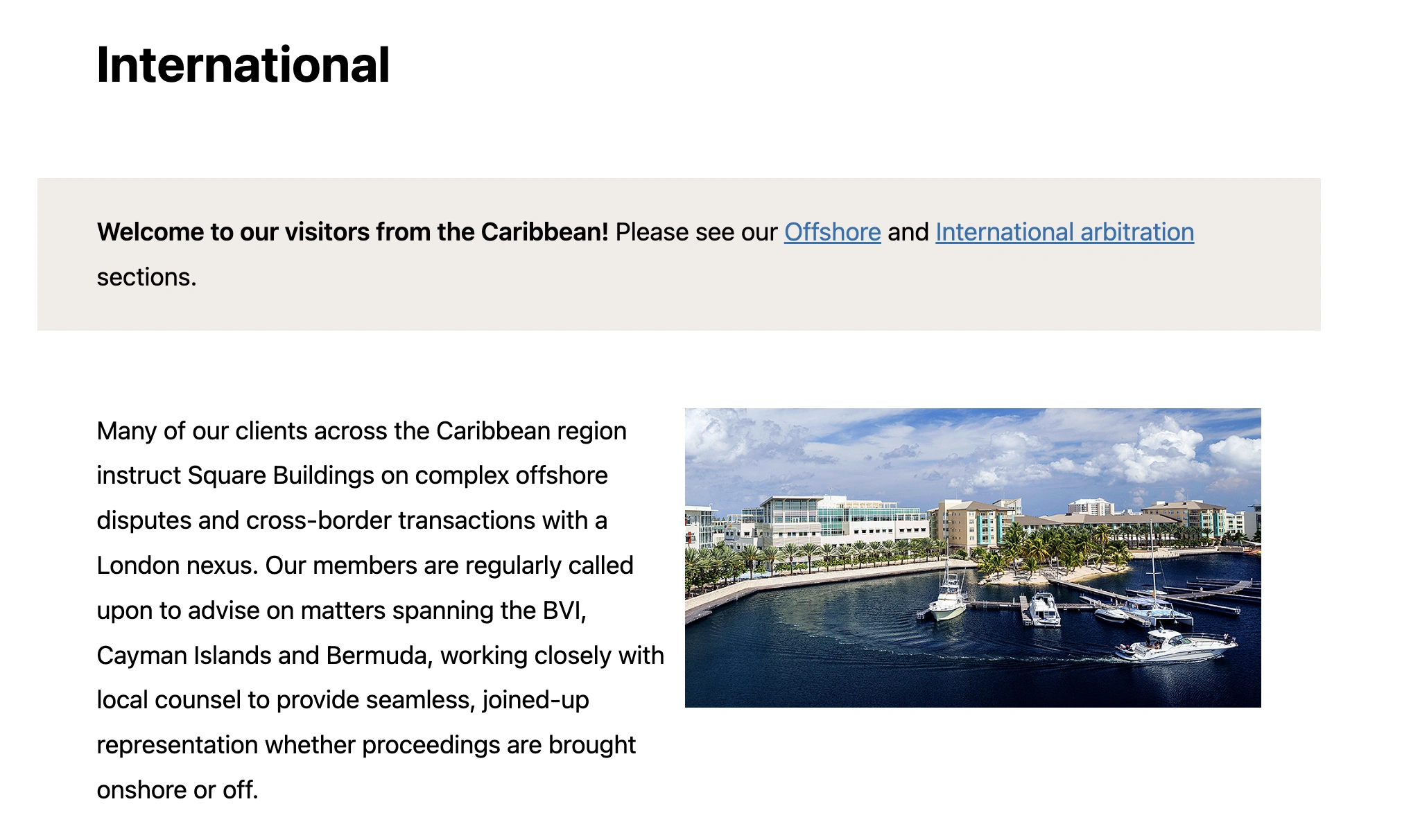
Different text and image content can be shown based on the visitor’s location.
Even relatively small adjustments can make the site feel far more relevant to international visitors.
Allowing visitors to filter expertise themselves
Another useful approach is giving visitors simple tools to refine what they see.
For example, a site might allow visitors to filter barristers or lawyers by:
- practice area
- sector
- jurisdiction
- seniority
- type of work (advisory, litigation, arbitration)
When combined with well-structured content, this kind of filtering allows visitors to quickly narrow down the list to the most relevant candidates.
Many modern search tools and indexing systems, such as Typesense or Elastic-based solutions, make this kind of faceted search possible while keeping the experience fast and intuitive.
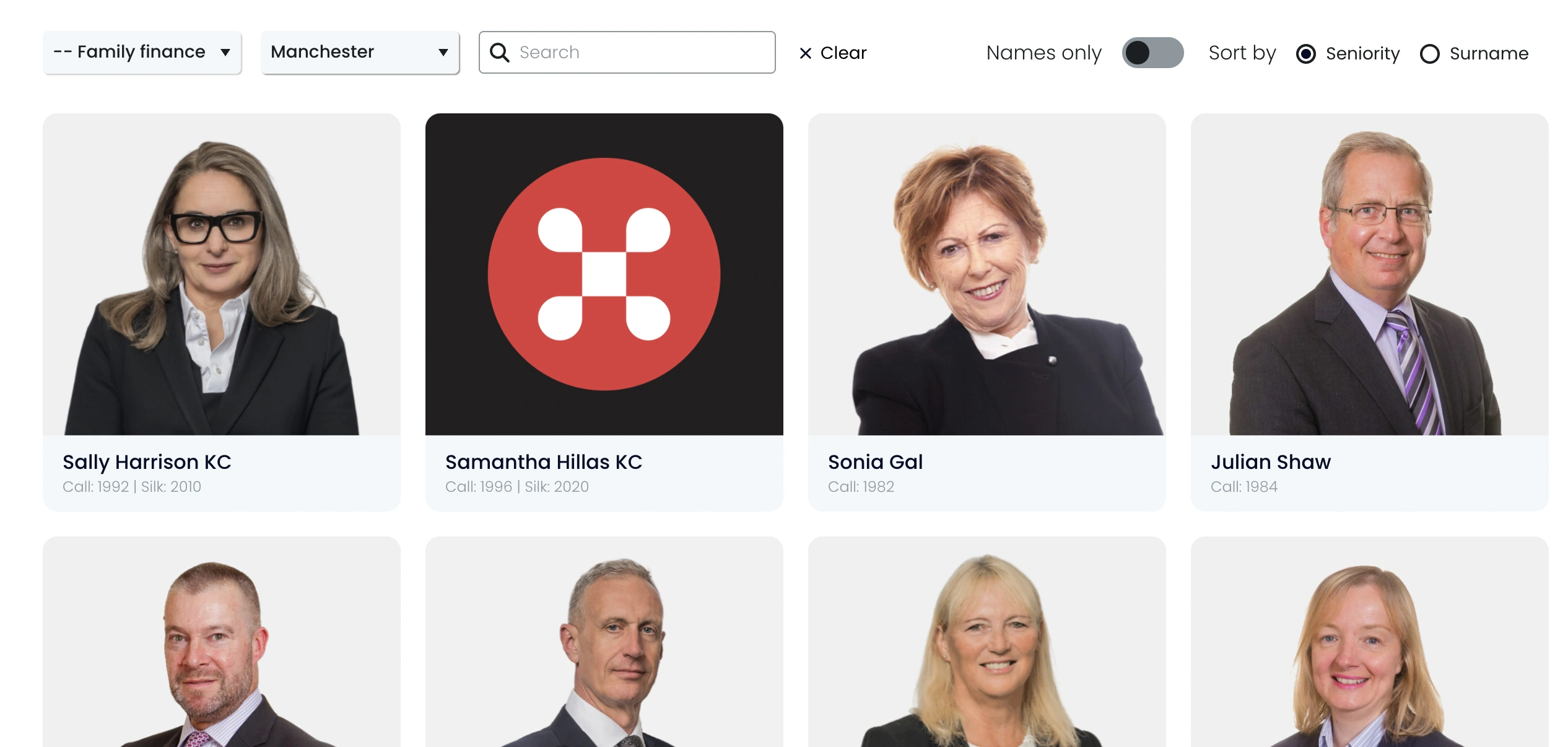
Our clients St. John’s Buildings have over 250 barristers. Superfast filter controls makes finding the right one easy.
For firms with large teams or broad expertise, this can dramatically improve the usability of the site.
Building on strong foundations
While these techniques may sound sophisticated, most of them rely on fairly simple building blocks.
The key foundations usually include:
- well-structured content
- consistent tagging of people, cases and topics
- flexible page templates that can combine different content types
- analytics that reveal how visitors actually use the site
Once these elements are in place, additional capabilities such as geolocation, behavioural targeting and personalisation can be introduced gradually.
For many firms, the first step is simply ensuring that their website content is structured in a way that allows it to be reused and recombined intelligently.
When that foundation exists, the website can begin to behave less like a static brochure and more like a system that actively helps visitors discover the expertise they need.
Preparing for a changing search landscape
There is another reason this approach is becoming increasingly important.
Search behaviour is changing. Clients are more likely to discover firms and chambers through search engines, AI-generated answers, or shared links to specific pieces of content.
When visitors arrive on a single page of the site, that page needs to do more than present isolated information. It should help them explore related expertise and understand the wider capabilities of the firm or chambers. Every important page becomes a gateway into your expertise.
A website that works harder
For professional services teams, the website is often the most important public expression of the brand and the primary place where potential clients evaluate expertise.
Moving beyond the brochure model allows the website to play a much more active role.
By structuring content intelligently, connecting related expertise and tailoring the experience for different audiences, firms and chambers can guide visitors towards the people and knowledge they need.
In doing so, the website becomes far more than a digital brochure. It becomes a powerful tool for discovery, trust and client engagement.