
Sustainable web design isn’t a one-off project. Once your website has been audited and optimised, the next step is building a long-term digital sustainability strategy that keeps your site efficient and environmentally responsible over time.
For law firms and barristers’ chambers, which are organisations with frequent publishing, large content libraries, and evolving teams, embedding sustainability into daily digital practice ensures your Environmental, Social, and Governance (ESG) commitments are reflected in your online presence year-round.
This final article in our series explores practical, achievable ways to integrate sustainable digital practices into your firm or chambers’ ongoing strategy.
ESG stands for Environmental, Social, and Governance
- Environmental: sustainability, carbon footprint, energy use, waste, climate impact.
- Social:employee welfare, diversity, community impact, human rights.
- Governance: leadership, transparency, ethics, risk management, policies.
Why long-term digital sustainability matters
Digital sustainability delivers benefits across multiple areas:
- ESG reporting
Environmental transparency is increasingly expected by clients and procurement teams.
(Source: PWC) - User experience
Fast, clean websites keep solicitors, clients and journalists engaged. - Accessibility
Lean code and simpler structures reduce barriers for users with disabilities.
(Source: W3C) - Operational efficiency
A streamlined site reduces maintenance costs and increases its useful lifespan.
Embedding sustainability ensures your investment in optimisation isn’t lost through future website bloat or inefficient publishing habits.
Build a sustainable content strategy
Law firms and chambers publish frequently: articles, cases, events, newsletters, webinars, pupillage information, and more. Without structure, this leads to unnecessary page duplication, large PDFs, or outdated material.
Create content lifecycle policies
Define how long each type of content should remain live before review. You can even remove the need to review content by setting an expiry date at the point of publication. Consider the following page types and see if there are any policies that can be set:
-
News: Some types of news naturally lend themselves to an expiry date more than others. For example, “new barrister announcements” may only need to remain live for 12 months. If the information is already duplicated elsewhere on the website, there’s no need to keep the news item indefinitely.
-
Events: Consider whether the event page will include post-event resources such as slide decks or video recordings. If not, interest may drop quickly after the event has passed, making it a good candidate for archiving.
-
Webinars: If your site hosts or links to webinar recordings or slide decks, review them regularly to ensure the content is still current. Make sure any files are compressed and, where possible, hosted externally to keep your site lightweight.
-
Judicial or case updates: Review these annually to confirm they remain relevant and accurate.
A clear lifecycle prevents content sprawl and reduces carbon output.
Prioritise HTML over PDF
HTML pages (the standard, browser-based pages that make up most websites) are lighter, more accessible and far easier for search engines to understand. PDFs, by contrast, should be used only when fixed formatting must be preserved, such as forms or formal documents. For accessible PDF guidance, see the PDF/UA standard: https://www.iso.org/standard/75839.html
Set upload and publishing guidelines
Provide simple rules for clerks, barristers and marketing staff, such as:
- Images should be compressed to an appropriate maximum size.
- Profile photos should follow the agreed resolution and dimensions.
- PDFs should be reviewed for necessity and compressed if they must be used.
- Avoid duplicate files — check the WordPress media library before uploading.
- Videos should be hosted externally (Vimeo is a good option).
This prevents future inefficiencies without increasing workload.

Implement governance and accountability
A sustainable digital strategy needs clear ownership and well-defined processes to succeed. Without agreed responsibilities, even the best sustainability intentions can slip over time, outdated images creep back in, oversized PDFs are uploaded, or plugins go unmaintained. Assigning specific roles for content creators, editors, developers, and IT ensures that everyone knows what to check, what to approve, and when to act. Clear processes also make it easier to review performance regularly, enforce standards, and keep your website efficient, accessible, and environmentally responsible year-round.
Define roles
Common responsibilities include:
- Marketing team: quality control, accessibility, optimisation checks
- Clerks: content updates for barrister profiles and events
- IT / web team: hosting, caching, and performance monitoring
- Management: ESG and compliance oversight
Assigning ownership ensures sustainability isn’t forgotten during busy periods.
Create a sustainability checklist for all new content
Include items such as:
- Image optimisation
- Necessity of PDF usage
- Compression PDFs
- Accessible formatting
- Minimal use of third-party scripts
- Clean internal links
- Avoidance of unnecessary duplication
Checklists help non-technical staff maintain standards consistently.
Embedding sustainability in procurement decisions
Law firms and chambers regularly procure digital products: CMS platforms, hosting providers, analytics tools, CRM systems, event systems, and more.
Digital sustainability should be included in procurement criteria.
Questions to ask vendors
- Is your platform hosted on renewable energy?
- What is your data centre’s PUE score (energy efficiency)?
- How does your system handle caching and load distribution?
- How efficient is your API or CRM integration?
- Do you have a sustainability or carbon-reduction policy?
Helpful framework: ISO 14001 (Environmental Management Systems)
Prioritise lightweight tools and integrations
Tools that use excessive client-side JavaScript or multiple tracking scripts increase carbon output. Ask for alternatives or server-side solutions where possible.
Monitor performance and sustainability regularly
Once your site is optimised, maintain it through ongoing measurement.
Recommended monitoring tools
- Lighthouse (Chrome DevTools)
- WebPageTest
- Green Web Foundation Carbon Check
- Website Carbon Calculator
Schedule quarterly or biannual reviews
Include checks for:
- Page weight
- Image size compliance
- Script creep (new tools added over time)
- Accessibility scores
- Unnecessary new PDFs
- New PDFs or videos needing compression
- Outdated content or redundant pages
Legal websites change frequently; ongoing audits keep them lean.
Create a sustainability-led development culture
Digital sustainability becomes most effective when it influences everyday decisions.
Encourage sustainability training
Short workshops for clerks, barristers and marketers help them understand:
- Why optimising a headshot matters
- How to upload a PDF responsibly
- Why page performance affects search ranking
- How user journeys affect energy usage
Training improves long-term compliance.
Communicate your results publicly
Sharing sustainability achievements supports ESG transparency.
Ideas include:
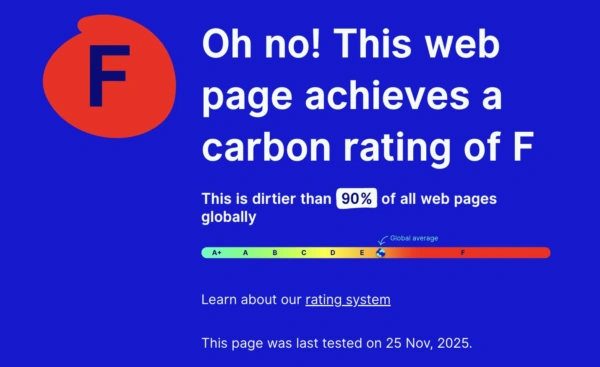
- Publishing your website carbon score there is also a badge you can add to your website.
- Adding a sustainability policy to your website alongside accessibility and privacy policies.
- Including digital sustainability in CSR reports.
- Highlighting improvements in tender submissions.
- Using the Green Web Foundation badge if hosted on renewable energy.

Plan for future redesigns with sustainability in mind
The average law firm or chambers website is redesigned every 4–6 years. When planning the next rebuild:
Choose a lightweight framework
Modern, efficient frameworks help your site load faster and use fewer server resources. This keeps energy consumption down and ensures long-term performance without unnecessary technical overhead.
Design for longevity, not trends
Trend-driven designs can date quickly and often require costly, resource-heavy redesigns. Prioritising clean, timeless layouts means your site stays relevant longer and avoids wasteful redevelopment cycles.
Use modular design systems
Building with reusable components keeps your codebase lean and consistent. This reduces duplication, makes updates easier, and prevents the kind of gradual “bloat” that slows websites and increases energy use over time.
Implement caching and CDNs early
Caching and content delivery networks (CDNs) store and serve content more efficiently, reducing load on your main server. This lowers energy consumption and speeds up your site for users wherever they are.
Ensure sustainability is written into the brief
Include environmental goals, like:
- Maximum target page size
- Minimal use of multimedia
- Renewable-energy hosting
- Strict control of third-party scripts
This aligns developers, designers and internal stakeholders from the outset.
Next steps
Embedding sustainability into your digital strategy ensures your website remains fast, efficient and environmentally responsible, not just today, but for years to come.
For law firms and chambers, the benefits are clear:
- stronger ESG performance;
- better user experience for clients and solicitors;
- improved accessibility;
- reduced operational costs;
- longer-lasting websites with less technical debt.
By establishing governance, improving workflows, training teams and incorporating sustainability into procurement and redesign planning, your organisation can maintain a digital presence that reflects both your professional values and your environmental commitments.
⸻
Previous posts in this series
- Why sustainable web design matters for legal websites
Why your website has a carbon footprint, how digital sustainability supports ESG goals, and why greener design leads to faster, more accessible and more efficient online experiences. - How to audit & optimise your website for sustainability
A practical, step-by-step guide including tools, templates, and legal-sector-specific optimisation ideas.