

Practice area profiles for chambers and services pages for law firms are the cornerstone pages of any legal website. They carry the primary search load for the site as a whole, and everything else, including barrister profiles, insight posts, sector pages and news, exists in part to support and reinforce them.
Getting their structure right therefore matters more than almost any other content decision on a legal website. A well-structured practice area page serves three audiences simultaneously: the human reader who arrives looking for relevant expertise, the search engine that needs to understand what the page covers, and the AI-powered answer tools that are increasingly shaping how people find and assess legal services.
This post sets out what good structure looks like for each of those audiences, and how the same structural decisions serve all three at once.
Why practice area pages carry the primary search load
Not everyone arrives at a legal website the same way, and understanding the difference matters when thinking about how a site should be structured.
Some visitors search by name. An instructing solicitor who has worked with a particular KC before, or an in-house counsel who has been given a recommendation, will search directly for that individual or their chambers. For these visitors, the website is a confirmation rather than a discovery tool. It validates a decision that has already largely been made.
Others arrive through the work itself. A solicitor researching options for a restructuring matter, a business owner looking for employment advice, or a general counsel trying to understand which sets handle a particular type of dispute will search for the area of law rather than a named individual or firm. They do not yet know who they are looking for. They are using search to find out.
A third group sits between the two. They know the landscape well enough to recognise several names, but they are actively comparing options before committing to an instruction. They may arrive via a named search but use the website to assess depth of experience, the strength of the team, and whether the practice matches the specific nature of their matter. For this group, a well-structured practice area page is not a discovery tool or a confirmation, it is a deciding factor.
All three types of search are common and entirely valid. But they place different demands on a website. Named searches require little more than a findable, credible presence. Category searches require content that is clearly structured and visible to someone with no prior knowledge of the set or firm. Comparison searches require both the credibility to reassure and the depth to persuade.
Practice area pages serve all three, but they carry the heaviest load for the second and third types. They are the pages that answer the question “who handles this kind of work?” and “why this set rather than another?” They are also the pages that everything else on the site points back to. A thought leadership article on restructuring trends derives much of its search value from its connection to the practice area page it supports. A barrister profile gains context and authority from the practice areas it references.
Without strong, well-structured practice area pages at the centre, the rest of the site has less to anchor to. For visitors who already know who they are looking for, a weak practice area page is a missed opportunity. For visitors who do not, it may mean the chambers or firm is never found at all.
Why structure matters for readers
Visitors rarely arrive on a legal website ready to read a long, detailed explanation from beginning to end. Most people start by scanning the page to understand whether the content is relevant to their problem. Only if it appears useful do they continue reading.
Practice area pages work best when information is layered, so that different readers can find what they need at the depth they require.
A simple way to think about layering
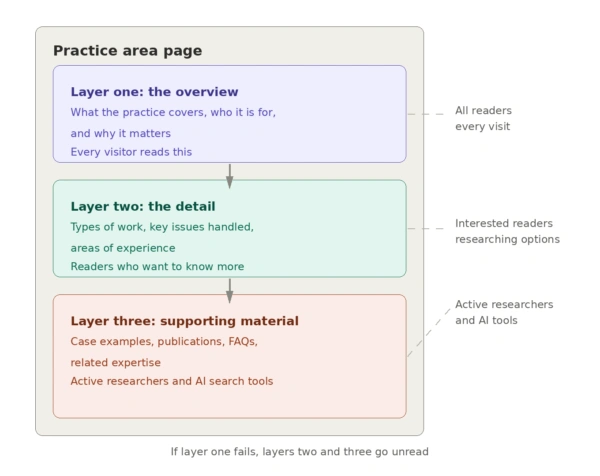
Think of a practice area page in three levels:
- Layer one, the overview: a clear, concise summary of the practice area or service. What it covers, who it is for, and why it matters. This is what a time-poor reader needs to assess relevance quickly.
- Layer two, the detail: specific types of work, key issues handled, and areas of experience. This is where a reader who has decided the page is relevant will look next.
- Layer three, the supporting material: case examples, publications, insights, related expertise, and FAQs. This depth rewards the reader who is actively researching.
No single reader needs all three layers. But every reader needs layer one to work well, or they will not reach layers two and three. Pages that open with a lengthy narrative history of the practice area, or that lead with directory rankings before explaining what the practice actually does, are failing layer one.
Why structure matters for traditional search
Search engines have long responded well to pages that are clearly structured, with meaningful headings that accurately describe the content beneath them and well-organised sections that guide a reader logically through the page.
For practice area pages, the practical implications are straightforward:
- The page title and opening paragraph should clearly state what the practice area covers.
- Headings and subheadings should reflect the actual content of each section, not serve as generic labels.
- Related practice areas, sectors, and expertise should be linked clearly so search engines can understand the relationships between pages.
- Pages should avoid long, undifferentiated blocks of text that make it difficult to identify the primary topics covered.
These are not new principles. But they are frequently overlooked on legal websites where content has grown organically and structural consistency has not been maintained.
Why structure now matters for AI-generated search answers
Search behaviour is changing in ways that are directly relevant to how practice area pages need to be written.
AI-powered search tools, including Google’s AI Overviews, ChatGPT and Perplexity, increasingly generate direct answers to queries rather than simply returning a list of links. These answers are drawn from web pages that the AI judges to be authoritative and clearly structured.
The emerging discipline of answer engine optimisation (AEO) is concerned with how organisations can ensure their own content is the source that AI systems draw from, rather than a competitor’s page or a third-party directory.
For chambers and law firms, this creates a specific and underappreciated risk. A set or firm with a strong reputation may find that AI-generated answers about its area of expertise draw primarily from Chambers and Partners, Legal 500, or other directory sites, because that is where the most clearly structured, descriptive content about its work currently lives. The chambers’ or firm’s own website, however well-regarded, may be credential-heavy but answer-light: strong on names, rankings and case references, but containing little content that directly addresses the questions a potential client is likely to ask.
The evidence on what drives AI citation is still developing, and the signals used by different AI systems are not fully or publicly documented. However, the available evidence suggests that pages structured to answer specific questions directly, using clear headings, concise paragraphs, and well-organised explanations, are more likely to be drawn upon than pages that present information in long, undifferentiated blocks.
Improving the structure of practice area pages is therefore likely to support both traditional search visibility and emerging AI search behaviour, even if the precise mechanisms continue to evolve.
The reputational query problem
There is a related issue that affects chambers in particular.
Queries such as ‘leading restructuring barristers in London’ or ‘top chambers for commercial dispute resolution’ are increasingly answered directly by AI search tools. At present, the content used to answer those queries tends to come from Chambers and Partners, Legal 500, and similar directories, not from the chambers’ own website.
This happens because directories publish clearly structured, descriptive assessments of a set’s standing in a particular area. That content is well-organised, consistently formatted, and directly answers the kind of reputational queries being asked. Many chambers websites, by contrast, present similar information as pull-quotes in testimonials sections or within long narrative paragraphs, formats that are harder for AI systems to identify and use as a source.
The practical response is straightforward. Practice area pages should include a brief, factual summary of the set’s standing and experience in that area, written in clear prose and structured so that it can be read and indexed independently of surrounding content. This does not require exaggerated claims. A clear, factual description of the work undertaken, the clients served, and the depth of experience available is both more credible and more useful than promotional language.
The value of FAQ content
One of the most practical structural additions a practice area page can make is a dedicated FAQ section.
AI systems appear to favour content that directly addresses the kinds of questions potential clients are likely to ask. These tend to fall into a few natural categories:
- Definitional questions: what a particular process or instrument involves
- Procedural questions: how a particular process works in practice
- Comparative questions: how one approach differs from another
For a restructuring practice, for example, relevant questions might include what options are available for a distressed business, how early legal advice should be sought, or how different restructuring tools compare.
Five to eight FAQs per practice area is a practical target for most chambers and firms, scaled to the depth of the practice. Answers work best when they are concise, clearly written, and where appropriate reference a relevant statute, instrument, or leading case. This kind of authoritative, specific content is more likely to be useful to a reader and more likely to be drawn upon by AI search tools than general or promotional language.
As with all content on practice area pages, FAQ answers should be reviewed carefully by practitioners to ensure accuracy and appropriate framing.
Direct access and public-facing content
For chambers that accept direct access instructions, and for law firms that serve the public directly, the stakes around page structure are higher still.
Traditional chambers marketing is largely directed at instructing solicitors and legal professionals who know how to find and assess a set. That audience tends to use directories, referrals, and established relationships. Members of the public approaching a barrister or firm directly behave very differently. They are far more likely to begin with an AI-powered search, asking conversational questions such as ‘can I instruct a barrister without a solicitor’, ‘how do I find a barrister for an employment dispute’, or ‘what does direct access mean’. These are precisely the kinds of queries that AI tools answer directly, drawing from whatever content they judge to be the clearest and most authoritative source.
For direct access chambers and consumer-facing law firms, this creates a specific and pressing opportunity. If a practice area page or direct access explainer is not structured to answer these questions clearly and in plain language, the chambers or firm will not appear in the answers that matter most to the audience it is trying to reach.
There is also a plain language dimension that is easy to overlook. AI tools tend to favour content that is clearly written and accessible. Legal content written primarily for a professional audience, dense with procedure and qualification, is less likely to be cited in response to a public-facing query than content that explains the same information in straightforward terms. Direct access chambers and consumer-facing firms therefore have both more to gain from well-structured content and more reason to ensure their pages are written with a non-specialist reader in mind.
What a well-structured practice area page looks like
Bringing these principles together, a well-structured practice area page for a chambers or law firm typically follows this pattern:
- A clear opening paragraph that states what the practice covers, who it serves, and what distinguishes the set or firm’s approach. This is the layer one overview and it needs to work for a reader who goes no further.
- A section on types of work handled, broken into specific areas with short descriptive paragraphs under each. This is where the detail lives and where related links to specific sub-practices or sectors should appear.
- A section on experience and standing, written in factual prose rather than as a collection of directory pull-quotes. This is the content that addresses reputational queries and gives AI tools something authoritative to draw from.
- Examples of relevant instructions or matters, described at a level of detail that is useful to a reader without compromising confidentiality.
- Related expertise, sectors, or linked practice areas, clearly signposted so readers and search engines can navigate to relevant content.
- A FAQ section of five to eight questions, covering the definitional, procedural, and comparative questions that potential clients and instructing solicitors are most likely to ask.
This structure serves readers who scan and readers who research. It gives search engines clear signals about the page’s topics and relationships. And it gives AI tools the kind of directly answerable, well-organised content they are most likely to cite.
The pages that perform best in all three contexts are not the most heavily designed or the most creatively written. They are the most clearly structured.
In summary
Practice area profiles and services pages are central to how chambers and law firms present their expertise online. They carry the primary search load for the site, anchor all other content, and are increasingly the pages from which AI-powered search tools draw their answers.
Getting their structure right is not a technical exercise. It is an editorial one. The decisions about how to layer content, what questions to answer, how to describe standing and experience, and where to place supporting material all shape how well a page serves its three audiences: readers, search engines, and AI tools.
The good news is that the structural decisions that serve readers best, clear layering, direct answers, and well-organised explanations, are also the ones that perform best in both traditional and AI-powered search. There is no trade-off between writing for people and writing for search. The same principles apply to both.
Frequently asked questions
What is answer engine optimisation?
Answer engine optimisation (AEO) refers to the practice of structuring web content so that it is more likely to be drawn upon by AI-powered search tools when generating direct answers to queries. Tools such as Google’s AI Overviews, ChatGPT and Perplexity increasingly respond to searches with a synthesised answer rather than a list of links, pulling from pages they judge to be authoritative and clearly structured.
AEO differs from traditional search engine optimisation (SEO) in that the goal is not simply to rank highly in a list of results, but to be the source an AI system cites when answering a specific question. A page can perform well in conventional search while still being absent from AI-generated answers if it is not structured to provide direct, citable responses.
It is worth noting that AEO is an emerging discipline. The signals that determine AI citation are not fully documented, and best practice continues to evolve.
How does AEO apply to chambers and law firm websites?
For chambers and law firms, the practical implication of AEO is that practice area pages and services pages need to do more than list credentials and case references. AI systems scanning those pages look for content that directly answers the questions a potential client might ask.
A page that is strong on names, rankings, and accolades but contains no structured explanations or direct answers is unlikely to be cited, regardless of the reputation of the set or firm behind it. Structuring pages with clear headings, concise explanations, and well-organised FAQ sections makes it more likely that the page will be identified as a useful source.
Why does AEO matter for chambers?
For chambers, there are two reasons AEO deserves attention.
The first is reputation and visibility. Chambers have long cared about how they appear when specific terms are searched, and appearing ahead of competitors for relevant queries is a marker of standing. AI search is an extension of this. As AI-generated answers become a more prominent part of how people find and validate expertise, being cited in those answers carries the same reputational weight as ranking well in conventional search. Being absent carries the same risk as not ranking at all.
The second is a shift in behaviour that is already under way. Legal professionals have been among the earliest and most active adopters of AI tools. Research published by Thomson Reuters suggests that the overwhelming majority of legal professionals expect AI to be central to their workflows within the next five years. While sector-specific data on how often AI tools are used to identify or validate legal expertise remains limited, the direction of travel is clear. It is reasonable to expect that AI-assisted research will influence how instructing solicitors and in-house counsel identify and assess chambers, even if the precise mechanisms are not yet fully visible.
Getting practice area pages right now is about being prepared for that moment rather than catching up after it has passed. The structural decisions made during a website build or redesign are significantly harder to reverse once a site is live. Building AEO into the content architecture from the outset means the investment works harder from the start.
Why does AEO matter for law firms?
For law firms, AEO matters for reasons that are both competitive and structural.
The competitive dimension is most visible in crowded practice areas. When a potential client, whether an individual, a business, or an in-house team, uses an AI tool to research legal options, the firms that appear in the generated answer are not necessarily the most prominent or the most highly ranked in directories. They are the firms whose content is best structured to answer the question being asked. In practice areas where several firms offer broadly comparable services, content architecture can become a meaningful differentiator at precisely the moment a potential client is forming a view.
For firms that serve the public directly, the position is closer to that of direct access chambers. Members of the public researching legal help are increasingly likely to begin with an AI-powered search, asking conversational questions such as ‘do I need a solicitor for an employment tribunal’ or ‘how do I make a claim for unfair dismissal’. Firms whose content answers those questions clearly and in plain language are significantly better placed than those whose pages are written primarily for a professional or directory audience.
The broader behavioural shift is also relevant. Legal professionals, including in-house counsel who instruct external firms, have been among the earliest adopters of AI tools in their working lives. Research from Thomson Reuters suggests that the vast majority of legal professionals expect AI to be central to their workflows within the next five years. As AI-assisted research becomes routine, the firms that appear authoritatively in AI-generated answers will have a material advantage in how they are identified, assessed, and ultimately instructed.
As with chambers, the strongest argument for acting now is timing. Firms that build AEO into their content architecture during a website build or review are better placed than those who treat it as a retrofit. The structural decisions are easier to get right from the outset than to correct after the fact.
Does AEO matter more for direct access chambers?
For chambers that accept direct access instructions, AEO is not simply a search visibility consideration. It is a client acquisition one.
Traditional chambers marketing is largely directed at instructing solicitors and legal professionals who know how to find and assess a set. That audience tends to use directories, referrals, and established relationships. Members of the public approaching a barrister directly behave very differently. They are far more likely to begin with an AI-powered search, asking conversational questions such as ‘can I instruct a barrister without a solicitor’, ‘how do I find a barrister for an employment dispute’, or ‘what does direct access mean’. These are precisely the kinds of queries that AI tools answer directly, drawing from whatever content they judge to be the clearest and most authoritative source.
For direct access chambers, this creates a specific and pressing opportunity. If a practice area page or direct access explainer is not structured to answer these questions clearly and in plain language, the chamber will not appear in the answers that matter most to the audience it is trying to reach. A competitor whose content is better structured may be cited instead, regardless of the relative quality of the barristers involved.
There is also a plain language dimension that is easy to overlook. AI tools tend to favour content that is clearly written and accessible. Legal content written primarily for a professional audience, dense with procedure and qualification, is less likely to be cited in response to a public-facing query than content that explains the same information in straightforward terms. Direct access chambers therefore have both more to gain from AEO and more reason to ensure their content is written with a non-specialist reader in mind.
Why do directory sites currently outperform chambers websites in AI search answers?
When AI tools answer queries such as ‘leading restructuring barristers in London,’ they tend to draw from Chambers and Partners, Legal 500, and similar directories rather than from chambers’ own websites.
This happens because directories publish clearly structured, descriptive assessments of a set’s standing in a particular area. That content is well-organised, consistently formatted, and directly answers the kind of reputational queries being asked. Many chambers websites, by contrast, present similar information as pull-quotes in testimonials sections or within long narrative paragraphs, formats that are harder for AI systems to identify and use as a source.
The response is not to replicate directory content, but to ensure that practice area pages include a clear, factual description of the set’s experience and standing, written in indexable prose.
What does content layering mean in practice?
Content layering means organising a page so that information is presented in descending order of detail. A visitor scanning quickly can find what they need near the top of the page, while a visitor researching in depth can continue further down.
For a practice area page, this typically means an overview of the work handled at the top, followed by more specific types of instructions or experience, followed by supporting material such as case examples, publications, and FAQs. Each layer serves a different type of reader without requiring any of them to work through content that is not relevant to them.
How many FAQs should a practice area page include?
For most practice areas, five to eight FAQs is a practical target. Fewer than five tends to feel thin, while more than eight risks overlap and repetition.
The right number depends on the depth of the practice. A broad, well-developed area such as insolvency and restructuring can support eight distinct questions across definitional, procedural, and comparative topics. A narrower practice area may be better served by five or six carefully chosen questions.
FAQs work best when they address questions a potential client or instructing solicitor would genuinely ask, rather than questions that simply restate what the page already covers.