
WordPress 7.0, released on 20 May 2026, marks another significant step in the platform’s evolution, with a strong focus on AI-assisted content management, editorial workflows, and a more integrated publishing experience.
For chambers, law firms, and professional services organisations, the practical impact is less about dramatic visual redesigns and more about improving internal efficiency, content governance, and long-term flexibility.
Many legal-sector websites understandably prioritise stability and consistency over adopting every new feature immediately. However, WordPress 7.0 introduces several developments worth paying attention to: particularly its AI features.
AI features are becoming part of the WordPress ecosystem
The clearest direction of travel in WordPress 7.0 is the growing integration of AI-powered tools into content creation and administration.
While AI functionality varies depending on plugins and hosting environments, the wider WordPress ecosystem is rapidly moving towards:
- AI-assisted drafting and editing
- Content summarisation
- SEO suggestions
- Metadata generation
- Accessibility improvements
- Internal linking recommendations
- Image generation and optimisation
- Workflow automation
For legal organisations, this is unlikely to replace professional drafting or legal review. Instead, the practical benefits are more operational.
Easy integration with your preferred AI tools
A new Connectors section in the WordPress settings area allows you to plug in an API key from Anthropic, OpenAI, Google or other services.
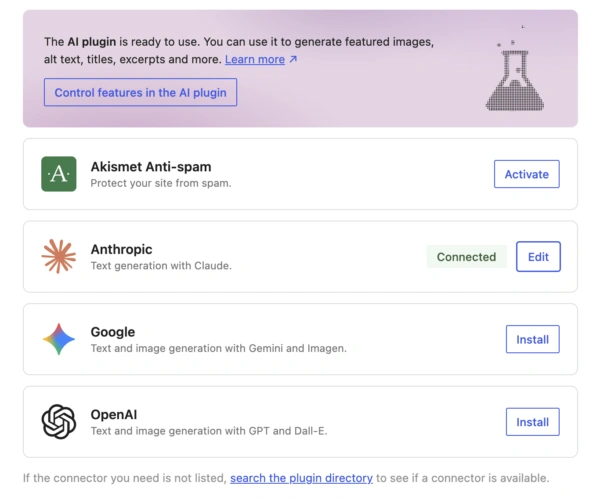
Connect your preferred AI tools using the new Connectors section in your WordPress dashboard.
Potential use cases include:
Faster first drafts for marketing teams
AI tools can help produce initial drafts for:
- News updates
- Event announcements
- Recruitment pages
- Practice area introductions
- Seminar summaries
- Legal insight articles
This can significantly reduce the time spent creating routine marketing content while still allowing full editorial oversight.
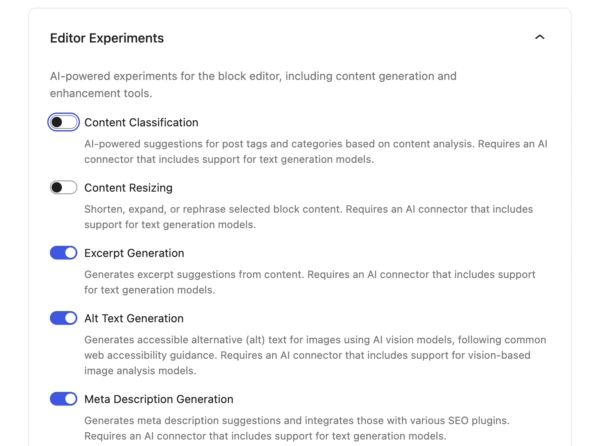
New AI features in WordPress 7.0, for sites using the block editor
Improved SEO support
Many popular SEO plugins are expected to expand their AI functionality following the WordPress 7.0 release.
This may include:
- Automated meta descriptions
- Suggested headings
- Content structure recommendations
- Keyword optimisation guidance
- Readability improvements
For chambers and law firms competing in increasingly crowded search results, these tools may help improve consistency without requiring extensive SEO knowledge internally.
Better accessibility and content consistency
AI-assisted tools are also increasingly being used to:
- Suggest ALT text for images
- Improve heading structures
- Identify readability issues
- Flag accessibility concerns
For professional organisations with large websites and multiple contributors, this can help maintain higher publishing standards over time.
Editorial workflows are continuing to improve
One of the more anticipated developments around modern WordPress workflows has been collaborative commenting and editorial feedback directly within the editor.
This would be particularly valuable for:
- Chambers marketing teams
- Multi-author law firm websites
- External communications review
- Practice group approvals
- Compliance sign-off processes
Some of the more advanced collaborative commenting functionality appears to have been pushed into future releases, but the overall direction is clear: WordPress is steadily improving its built-in editorial workflow tools.
This should eventually reduce reliance on lengthy email chains and disconnected document review processes.
Plugin developers are likely to move quickly
Major plugin developers are expected to build additional functionality around WordPress 7.0 relatively quickly, particularly in areas such as:
- AI-assisted SEO
- Content generation
- Editorial workflows
- Accessibility auditing
- Search functionality
- Automation tools
- Analytics integration
Plugins likely to evolve rapidly include:
- Yoast SEO
- Rank Math
- Jetpack AI
- Gravity Forms integrations
- Search and knowledge-base plugins
For legal-sector websites, the key consideration will be balancing innovation with stability and compliance.
Not every AI feature will be appropriate for professional legal publishing, particularly where accuracy and regulatory considerations are important.
Stability remains the priority
As with any major WordPress release, compatibility remains an important consideration.
Many legal-sector websites rely on bespoke themes, specialist plugins, ACF-driven functionality, and third-party integrations. While WordPress 7.0 appears to maintain good backward compatibility overall, occasional issues can still arise after major updates.
We have already updated WordPress to the latest version on all our support package client sites. In case any issues are discovered, we can roll you back to the previous version and investigate.
A gradual transition remains the sensible approach
For most chambers and law firms, WordPress 7.0 is unlikely to trigger an immediate redesign or major change in how websites are managed day to day.
However, it does reinforce several longer-term trends:
- AI-assisted publishing is becoming mainstream
- Editorial collaboration is improving
- Structured content systems are becoming more valuable
- Modern WordPress workflows are becoming increasingly sophisticated
Many legal-sector websites will continue using more traditional editorial setups for now, which remains entirely valid. The key is adopting genuinely useful improvements where they provide practical value, without introducing unnecessary complexity.
The most successful legal-sector implementations will continue to prioritise:
- Stability
- Professional presentation
- Editorial control
- Accessibility
- Ease of use
- Long-term maintainability
Rather than adopting every new feature immediately, the focus should remain on introducing improvements in a controlled and commercially sensible way.